 Twitter
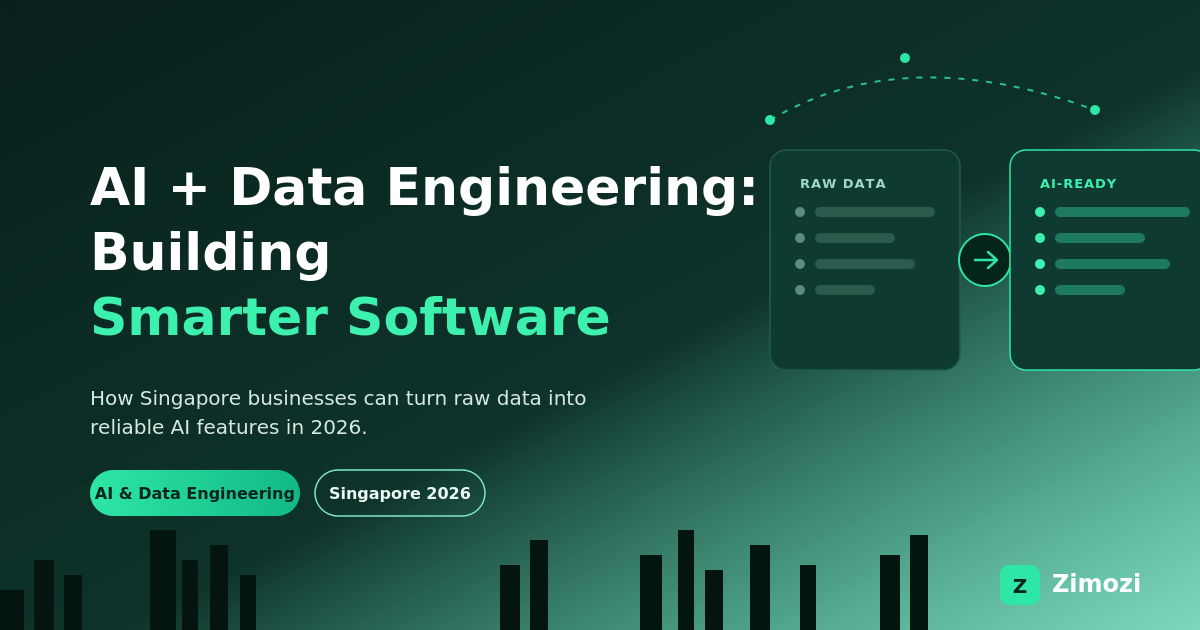
AI data engineering Singapore helps businesses connect reliable data with AI-powered software products. Data engineering provides the pipelines, storage, processing, and data structures that AI applications need to work with relevant information.
This is where AI and data engineering need to work together.
AI can help software understand information, classify content, generate responses, support predictions, and automate certain tasks. Data engineering provides the pipelines, storage, processing, and data structures that allow those AI features to work with the right information.
For Singapore businesses building new software products or improving existing applications, AI data engineering Singapore projects can bring these two areas together as part of a practical software architecture.
What Is AI Data Engineering Singapore?
AI data engineering refers to the work involved in collecting, organising, processing, and delivering data for AI applications.
A software product may need information from several sources, including:
- Customer databases
- Business applications
- Websites and mobile apps
- Documents
- Transaction systems
- CRM platforms
- Internal databases
- Third-party APIs
Data engineering connects these sources and prepares the information for use.
AI data engineering Singapore projects can organise this information so AI applications can access the data required for specific business tasks.
The AI layer can then use that data for tasks such as classification, recommendations, forecasting, search, summarisation, and workflow automation.
AI and data engineering have different roles. AI provides the intelligence needed for a particular task, while data engineering helps make the required information available in a reliable and usable form.
Why Data Matters for AI Software
An AI application can produce poor results when the underlying data is incomplete, outdated, duplicated, or difficult to access.
Consider a software product used by a sales team. The product may contain customer profiles, sales activity, previous communications, product information, and transaction records.
If these sources are stored separately and are not updated consistently, an AI assistant may not have the information it needs to provide a useful response.
A better approach is to understand where the data comes from, how it is processed, and how it moves through the application.
This is why AI data engineering Singapore projects should consider the data foundation during product planning rather than adding it after the AI feature has already been developed.
Build Reliable Data Pipelines
A data pipeline moves information from one system to another and prepares it for storage, reporting, or application use.
For an AI-enabled software product, a pipeline might:
- Collect information from business systems.
- Validate incoming data.
- Identify and manage duplicate records.
- Transform data into a consistent format.
- Store the information in the appropriate database or data platform.
- Make the required information available to the application or AI system.
A well-designed AI data engineering Singapore architecture can help keep data pipelines organised as the software product grows.
The exact architecture depends on the product.
A small application may need only a few connected data sources. A larger SaaS product may require multiple pipelines, databases, APIs, and processing systems.
The goal should be to build the data infrastructure that the product actually needs.
Connect AI With Business Data
An AI model does not automatically understand a company’s internal information.
If a business wants an AI assistant to answer questions about its documents, products, customers, or processes, the application needs a way to access relevant information.
One common approach is Retrieval-Augmented Generation, or RAG.
With RAG, an application can search a connected knowledge source, retrieve relevant information, and provide that information to an AI model when generating a response.
For example, a Singapore company could build an internal knowledge application for employees.
An employee could ask:
What documents are required for this customer onboarding process?
The application can search approved internal documents, retrieve the relevant information, and provide it to the AI model before generating a response.
This approach can be useful when information changes regularly and needs to remain connected to the application.
AI data engineering Singapore can also help businesses connect AI applications with approved internal data sources.
How AI Data Engineering Supports Software Products
AI data engineering can support different types of software features. It is not limited to chatbots or AI assistants.
Personalised Recommendations
An application can use customer behaviour and product information to provide relevant recommendations.
The data pipeline needs to collect the required activity data and make it available to the recommendation system.
Intelligent Search
Businesses with large amounts of information can use AI-supported search to help users find relevant documents, products, or records.
The underlying data needs to be organised and indexed so the search system can retrieve useful information.
Document Processing
Businesses often work with invoices, forms, reports, contracts, and other documents.
AI can help extract or classify information from these documents. Data engineering can then move the extracted information into the appropriate business system.
Business Forecasting
Some applications use historical data to support forecasting and planning.
The quality of the results depends partly on whether the data is collected consistently and prepared correctly.
These examples show why the AI feature and the data foundation should be considered together.
AI Data Engineering for SaaS Products
SaaS products have additional considerations because the same application may serve many customers.
For example, a SaaS platform could use AI to analyse information uploaded by customers.
The system needs to ensure that one customer’s information is not exposed to another customer. Data access, tenant separation, authentication, permissions, and application logic therefore need to be designed carefully.
The data architecture also needs to consider:
- Where customer data is stored
- How data is separated between customers
- Who can access specific information
- How data is updated
- How long information is retained
- How AI services receive and process the data
For SaaS businesses, AI data engineering Singapore solutions are therefore closely connected with application architecture and security.
Security and Data Protection
AI applications can process personal information, business documents, customer records, and other sensitive data.
Businesses should determine what information the application collects, where it is stored, who can access it, and how it is transferred between systems. Businesses handling personal data in Singapore can refer to the Personal Data Protection Commission (PDPC) for guidance on data protection obligations.
Security controls can include:
- Authentication
- Role-based access
- Data encryption
- Secure API communication
- Data validation
- Logging and monitoring
- Data retention controls
- Human review for sensitive workflows
Businesses should also understand how data is processed by third-party AI services before connecting those services to business applications.
The appropriate controls depend on the type of information being processed and the purpose of the application.
Start With One Practical Use Case
Businesses do not need to build a large AI platform before testing whether an AI feature is useful.
A better starting point is often one clearly defined workflow.
For example:
Business problem: Employees spend too much time searching internal documents.
First version: Build an internal search assistant using approved company documents.
Data work: Connect the document repository, process the documents, and create a searchable knowledge base.
AI work: Use an AI model to retrieve relevant information and generate responses.
Testing: Check whether the system retrieves the correct information and handles questions it cannot answer.
Next step: Add more data sources only after the first workflow has been tested.
This approach makes it easier to understand the technical requirements before expanding the product.
What Businesses Should Decide Before Development
Before starting an AI-enabled software project, teams should answer several practical questions:
- What business problem are we trying to solve?
- What data does the application need?
- Where does that data currently live?
- How frequently does the data change?
- Who should have access to it?
- Does the application require real-time information?
- Which AI model or approach is appropriate?
- What happens when the AI produces an incorrect answer?
- How will the application be monitored after launch?
These decisions help define the scope of an AI data engineering Singapore project before development begins.
These decisions can influence the database architecture, APIs, cloud infrastructure, AI model, security controls, and development requirements.
How Zimozi Can Support AI and Data Engineering
Zimozi works across AI and machine learning, AI agent development, data engineering, SaaS, web and mobile applications, software development, cybersecurity, and digital product development.
For an AI-enabled software product, these capabilities can work together.
For example, a business may need a web application where employees can search internal information using an AI assistant. The project could require a web application, data pipelines, an AI model, API integrations, authentication, and testing.
Each part can be planned around the complete workflow so that the application, data, and AI components work together.
Zimozi can support businesses with the development and integration work required for this type of application, based on the specific product requirements.
Conclusion
AI can add useful capabilities to software products, but those capabilities depend on the data available to the application.
AI data engineering Singapore projects bring the AI layer and data foundation together so businesses can build applications around reliable information, appropriate integrations, and clearly defined workflows.
For Singapore businesses considering an AI-enabled software product, starting with one manageable use case can make the technical requirements easier to understand before expanding the system.
If you are planning an AI-enabled software product, Zimozi can help assess the use case, data requirements, and technical architecture before development begins.