 Twitter
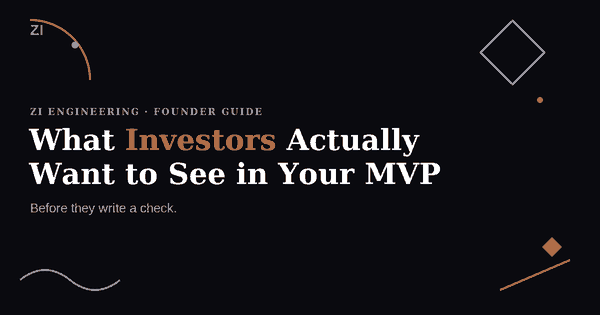
A working demo gets you in the room. Here’s what actually gets you the check.
Why a Working MVP Still Isn’t Enough
Most pre-seed founders assume that shipping something is the finish line. You built a product, it works, and people can click through it without it crashing. That feels like proof enough. Knowing what investors look for in an MVP, before you ever walk into the room, changes how you spend the months leading up to that meeting.
Investors see it differently. A working MVP tells them you can execute. It does not tell them whether anyone actually wants what you built, whether they will keep using it, or whether you know how to spend money wisely once you have more of it. Those are three separate questions, and a demo only answers the first one.
This is the gap that catches a lot of first-time founders off guard. You walk into a meeting proud of what you shipped, and the investor starts asking about numbers you have not been tracking. If you read our recent guide on MVP development budgets for startups, you already know that spending less does not automatically make you more fundable. What makes you fundable is what you do with the MVP once it exists.
What Investors Actually Look At
Before they write a check, most early-stage investors are running through a short mental list. It rarely gets said out loud in the meeting, but it shapes every question they ask. Here is what is actually on it.
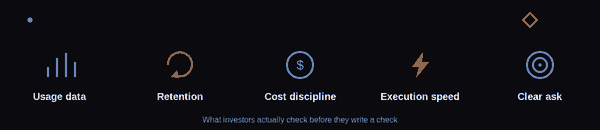
- Usage data that shows real behavior. Not signups, not waitlist numbers. Investors want to see what people do once they are inside the product: how often they come back, how far they get, where they drop off.
- A retention signal, even a small one. You do not need thousands of users. A handful of people who keep coming back week after week tells an investor more than a large number of people who tried it once.
- Cost discipline. How much did it cost you to get here, and did you spend it on the right things? Investors want founders who treat a small budget like it matters, because that habit does not change once the round closes.
- Team execution speed. How long did it take you to go from idea to working product, and how did you respond when something did not work? Speed and adaptability say more about your team than the product does.
- A clear, specific ask. How much are you raising, what will it fund, and what will be true in twelve to eighteen months if it works? Vague asks make investors nervous, because they suggest the founder has not thought the plan through.
Not sure your MVP is telling the right story yet? Get expert guidance on what to fix before your next investor conversation.
Mistakes That Make Investors Hesitate
Some of the most common reasons a promising MVP fails to convert into a check have nothing to do with the technology. They are about how the founder presents and manages what they have built.
Feature bloat is one of the biggest. Founders often add feature after feature to make the product look more complete, when a sharper, narrower product would have made the traction easier to see. One clear workflow that people actually use beats ten half-finished ones.
No north star metric is another. If you cannot say in one sentence what number you are trying to move, investors assume you have not decided what success looks like yet.
Hiding weak numbers instead of explaining them also backfires. Every early-stage product has some ugly metrics. Investors expect that. What worries them is a founder who glosses over the weak spots instead of showing they understand why the numbers look the way they do and what they are doing about it.
Burning through the whole pre-seed budget before validating anything is a fourth pattern. If a founder cannot show how far a dollar went, it raises the question of how far the next round will go too.
And finally, showing up without a clear ask. Even a strong product story falls flat if the founder cannot answer how much, for what, and what happens next, in a single breath.
Where ZI Fits In
This is exactly the gap we built ZI Engineering to close. Founders come to us with an idea and a limited budget, and our fractional engineering and product teams help them get to a launch-ready MVP without the overspend that so often derails a pre-seed round.
We also help founders think past the build itself. Through our Prepare for Investors support, we work with founders on the traction story, the metrics that matter, and the pitch itself, so the product and the narrative around it are ready at the same time. If you have not already, take a look at our guide on how to find the right investors for your startup, which covers the other half of this equation: knowing who to talk to once you are ready.
A Short Checklist Before You Raise
Before your next investor conversation, run through this list:
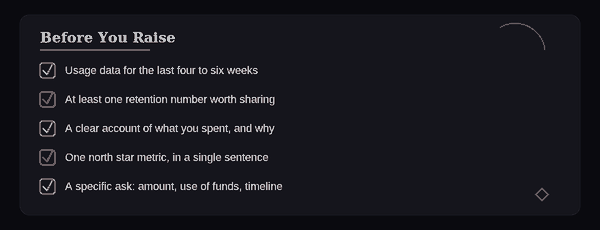
- Can you show usage data for the last four to six weeks, not just a signup count?
- Do you have at least one retention number you would be comfortable sharing?
- Can you explain exactly what you spent to get here and why?
- Do you know your one north star metric, and can you say it in a single sentence?
- Do you have a specific ask: an amount, a use of funds, and a twelve to eighteen month goal?
If you can answer all five with confidence, you are closer to investor-ready than most pre-seed founders in the room. Y Combinator’s own guidance on how to convince investors makes a similar point: clarity and evidence beat polish every time.
Ready to Get Investor-Ready?
A launch-ready MVP and a clear investor story do not have to happen by accident. If you want a second pair of eyes on where your product and your pitch currently stand, we are happy to help.